
As frontend developers, we’ve all grown comfortable with React Router as the de facto routing solution for React applications. However, the landscape is evolving, and TanStack Router presents a compelling case for modernizing how we handle routing in React applications. After working with both solutions in production environments, this comprehensive guide will help you understand why TanStack Router might be the upgrade your projects need.
The Current State of React Router: What’s Missing?
React Router has served the React community well for years, but several fundamental limitations have become increasingly apparent in modern development workflows. The most critical issue is the lack of comprehensive type safety. Despite TypeScript’s widespread adoption, React Router still treats parameters, search queries, and navigation as loosely-typed strings, leaving developers to manually implement type guards and validations.
Type Safety Gaps in React Router
React Router’s approach to type safety feels like an afterthought from the pre-TypeScript era. The useParams hook returns Record<string, string | undefined>, forcing developers to manually assert types and implement runtime validations. This becomes particularly problematic in large applications where route parameters flow through multiple components and functions.
// React Router - Manual type assertions required
const { userId } = useParams() as { userId: string }
// No compile-time guarantees that userId exists or is the correct type
The useLocation hook exemplifies this problem further. In React Router 6.9.0, the library switched from using unknown to any for location state, effectively disabling TypeScript’s ability to catch potential runtime errors. This decision reflects a concerning trend toward convenience over type safety.
Search Parameter Complexity
Managing URL search parameters in React Router requires significant boilerplate code and manual serialization/deserialization. Complex state objects must be manually converted to and from URL-safe strings, and there’s no built-in validation or type checking for these parameters.
Performance Limitations
React Router’s architecture can lead to performance issues in complex applications. Route matching and rendering lack optimization features like intelligent preloading or efficient cache management. Developers must implement these optimizations manually, often leading to inconsistent performance patterns across different parts of an application.
| Feature | React Router | TanStack Router |
|---|---|---|
| Type Safety | Manual type definitions required | Full TypeScript integration with generated types |
| Route Definition | Declarative JSX route configuration | File-base routing with code generation |
| Learning Curve | Gentle, follows standard React patterns | Moderate, requires TypeScript familiarity |
| Bundle Size | ~20KB minified | ~45KB minified |
| Parameter Validation | Manual validation in components | Built-in runtime validation and parsing |
| Search Parameters | String-based search parameter access | Type-safe search parameter handling |
| Route Preloading | Manual preloading implementation | Intelligent preloading with data dependencies |
| Code Splitting | Manual lazy loading setup | Automatic route-based code splitting |
| Data Loading | External data fetching libraries | Integrated loader pattern with suspense |
| Development Tools | Basic navigation debugging | Comprehensive devtools with route inspector |
| Community size | Large, established community | Growing, TanStack ecosystem |
| Migration Path | Incremental adoption possible | Requires architectural changes |
Table 1 - React Router vs TanStack Router Feature Comparison
TanStack Router: A Type-First Revolution
TanStack Router represents a fundamental shift in how we approach routing in React applications. Built from the ground up with TypeScript as a first-class citizen, it addresses every major limitation of traditional routing solutions while introducing powerful new capabilities.
Full Type Safety: Beyond Manual Assertions
The most transformative feature of TanStack Router is its comprehensive type safety. Unlike React Router’s string-based approach, TanStack Router generates precise TypeScript definitions for every aspect of your routing configuration.
// TanStack Router - Automatic type generation
const { issueId } = useParams({ from: '/issues/$issueId' })
// const issueId: string (fully typed and validated)

// Type-safe navigation
navigate({ to: '/issues/$issueId', params: { issueId: '123' } })
// TypeScript will error if issueId is missing or wrong type
The router automatically validates route parameters at build time, catching potential issues before they reach production. This level of type safety extends to search parameters, route context, and navigation methods.
File-Based Routing with Automatic Code Generation
TanStack Router’s file-based routing system automatically generates route configurations from your directory structure, eliminating boilerplate code and reducing the potential for configuration errors. The system uses intelligent naming conventions to determine route hierarchies and parameter structures.
src/routes/
├── __root.tsx           # Root layout
├── index.tsx            # Home route (/)
├── posts/
│   ├── index.tsx        # Posts listing (/posts)
│   └── $postId.tsx      # Post detail (/posts/:postId)
└── dashboard/
    ├── index.tsx        # Dashboard home
    └── settings.tsx     # Settings page
The TanStack Router plugin automatically generates type-safe route configurations from this structure, ensuring that your navigation code stays in sync with your actual route definitions.
Integrated Data Loading and Caching
One of TanStack Router’s most powerful features is its integrated approach to data loading. Rather than treating routing and data fetching as separate concerns, TanStack Router provides a unified API that coordinates both.
export const Route = createFileRoute('/posts/$postId')({
  loader: async ({ params }) => {
    return fetchPost(params.postId)
  },
  component: PostDetail,
})

function PostDetail() {
  const post = Route.useLoaderData()
  // post is fully typed based on loader return type
  // No loading states needed - handled by router
}
This integration eliminates the need for separate loading state management and provides automatic optimization features like intelligent preloading and cache deduplication.
Learning Curve: What to Expect When Migrating
The transition from React Router to TanStack Router involves both philosophical and technical shifts that developers need to understand and embrace. The learning curve is moderate but manageable, especially for teams already comfortable with TypeScript and modern React patterns.
Conceptual Shifts
The most significant mental shift involves moving from component-based route definitions to file-based routing. Developers accustomed to declaring routes in JSX need to adapt to a more filesystem-driven approach where directory structure directly maps to URL patterns.
// React Router approach
<Route path="/posts/:id" element={<PostDetail />} />

// TanStack Router approach - file: routes/posts/$postId.tsx
export const Route = createFileRoute('/posts/$postId')({
  component: PostDetail,
})
TypeScript Proficiency Requirements
TanStack Router assumes a solid understanding of TypeScript’s advanced features. Developers need to be comfortable with concepts like generic types, type inference, and module augmentation. The router’s type system is sophisticated, and while it provides excellent IntelliSense support, it can be overwhelming for developers new to advanced TypeScript patterns.
File-Based Routing Conventions
Understanding TanStack Router’s file naming conventions is crucial for effective usage. The system uses specific tokens and patterns to determine route behavior:
$parameterfor dynamic segments_layoutfor layout routes__rootfor the root layout- Directory nesting for route hierarchy
Benefits of the Learning Investment
Despite the initial learning curve, developers consistently report significant productivity improvements after adopting TanStack Router. The type safety catches bugs at compile time that would otherwise require runtime debugging, and the integrated data loading reduces the complexity of coordinating multiple async operations.
Real-world testimonials from development teams show that the initial time investment pays dividends in reduced debugging time and improved code confidence.
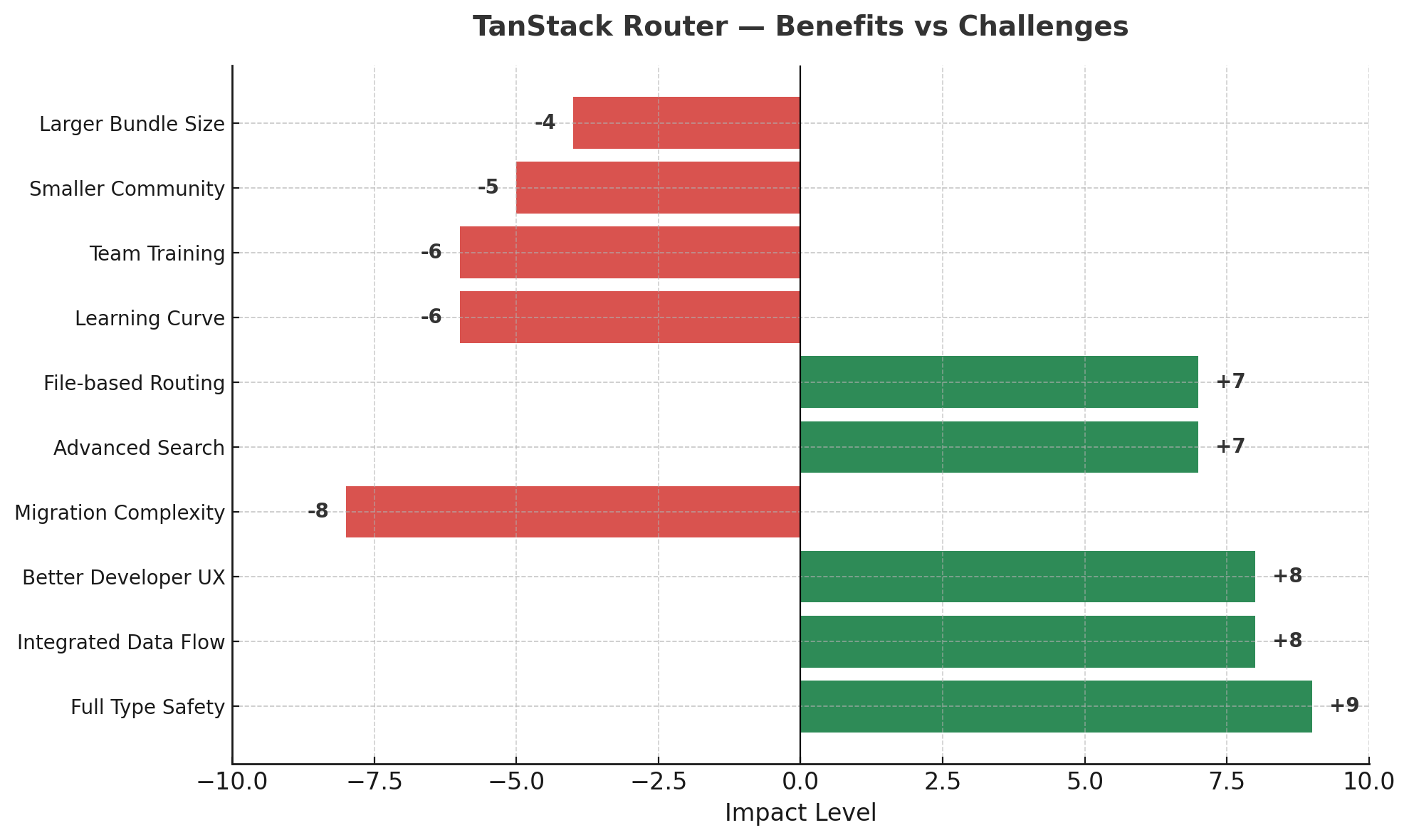
TanStack Router: Benefits vs Challenges Analysis (Impact Score 1-10)
Migration Complexity: Planning Your Transition
Migrating from React Router to TanStack Router requires careful planning and a systematic approach. The complexity varies significantly based on your current architecture, team size, and application complexity.
Assessment Phase
Before beginning migration, conduct a thorough assessment of your current routing setup:
- Route Inventory: Catalog all existing routes, including nested routes, protected routes, and dynamic segments
- Data Loading Patterns: Document how your application currently handles data fetching in relation to routing
- Type Safety Current State: Evaluate your existing TypeScript integration with routing
- Team Readiness: Assess your team’s TypeScript proficiency and capacity for learning new patterns
Migration Strategy Options
Big Bang Migration
For smaller applications (under 20 routes), a complete migration might be feasible. This approach involves:
- Installing TanStack Router dependencies
- Removing React Router completely
- Converting all routes to the new file-based structure
- Updating all navigation code
Incremental Migration
For larger applications, an incremental approach is often more practical:
- Set up TanStack Router alongside React Router
- Migrate routes in logical groups (e.g., by feature area)
- Gradually remove React Router dependencies
- Update testing and CI/CD processes incrementally
Common Migration Challenges
File Structure Reorganization
Moving from component-based to file-based routing often requires significant directory restructuring. Plan this carefully to minimize Git history disruption and team confusion.
Type Safety Implementation
Retrofitting full type safety into an existing application can uncover previously hidden type errors. Budget time for resolving these issues systematically.
Testing Updates
TanStack Router requires different testing patterns, particularly for route-level tests. The router’s integration with Suspense and error boundaries changes how you approach test setup.
Team Training
Ensure adequate time for team training and pair programming sessions. The concepts are different enough that even experienced React developers need time to adapt.
Migration Timeline Estimates
Based on real-world migration experiences:
- Small applications (5-15 routes): 1-2 weeks
- Medium applications (15-50 routes): 3-6 weeks
- Large applications (50+ routes): 2-3 months
These estimates include time for team training, testing updates, and addressing unforeseen issues.
Performance and Developer Experience Benefits
Runtime Performance Improvements
TanStack Router provides several performance optimizations out of the box:
- Intelligent Preloading: Routes and their data can be preloaded based on user intent (hover, viewport proximity)
- Automatic Code Splitting: Route-based code splitting happens automatically with file-based routing
- Efficient Cache Management: Built-in caching strategies reduce redundant network requests
Development Experience Enhancements
The development experience improvements are immediately apparent:
- Compile-time Error Detection: Route errors are caught during development rather than runtime
- Superior IntelliSense: IDE support provides accurate autocomplete for all routing operations
- Integrated DevTools: Comprehensive debugging tools provide visibility into route state and data loading
Bundle Size Considerations
TanStack Router’s bundle size (~45KB minified) is larger than React Router (~20KB minified), but this difference is often offset by the reduction in additional libraries needed for type safety, data fetching coordination, and state management.
Making the Case: When to Choose TanStack Router
For New Projects
TanStack Router is an excellent choice for new projects, particularly those that:
- Use TypeScript as the primary language
- Require sophisticated data loading patterns
- Need robust type safety for routing operations
- Plan to scale beyond simple page navigation
For Existing Projects
Migration makes sense when:
- Type safety is a priority and current routing lacks it
- You’re already using TanStack Query and want better integration
- Route-related bugs are a recurring problem
- The development team is comfortable with TypeScript and modern React patterns
When to Stick with React Router
React Router remains a solid choice for:
- Teams with limited TypeScript expertise
- Simple applications with straightforward routing needs
- Projects where bundle size is critically important
- Applications requiring immediate stability over cutting-edge features
Conclusion: The Future of React Routing
TanStack Router represents the evolution of React routing toward type safety, performance, and developer experience. While React Router has served the community well, the benefits of modern type-safe routing are compelling enough to justify the migration effort for many projects.
The decision ultimately depends on your team’s priorities: if type safety, developer experience, and integrated data loading are important to your project’s success, TanStack Router offers significant advantages over traditional routing solutions. The initial learning curve and migration complexity are temporary challenges that pay long-term dividends in code quality, developer productivity, and application reliability.
For teams starting new projects, TanStack Router should be seriously considered as the default choice. For existing projects, the migration complexity must be weighed against the substantial benefits, but the investment in modern, type-safe routing will likely prove worthwhile for applications with significant routing complexity.
The React routing landscape is evolving, and TanStack Router represents the direction that modern React development is heading. Embracing these changes now positions your team and projects for future success in an increasingly type-safe and performance-focused ecosystem.
Tags
- Software Development
- React
- React Router
- TanStack Router
- Routing